| Sign In | Join Free | My burrillandco.com |
|
| Ask Lasest Price | |
| Brand Name : | Tankii |
| Model Number : | Nickel copper |
| Certification : | ISO 9001 |
| Price : | |
| Payment Terms : | L/C, T/T, Western Union |
| Supply Ability : | 2000kg/month |
| Delivery Time : | 5-30 days |
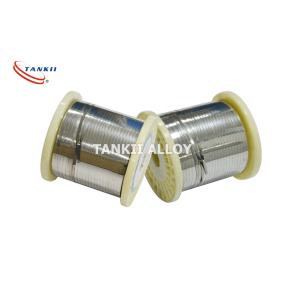
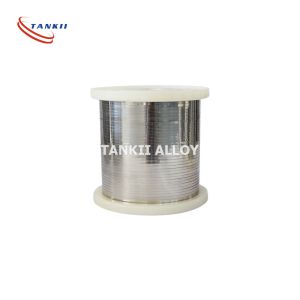
Copper CuNi10/CuNi2 Nickel Alloy Strip/Flat Wire For Resistor
CuNi2 Resistance Heating Wire
Copper Nickel 2 s a copper nickel alloy with the addition of Manganese to produce an alloy with a relatively low resistivity but high resistance to oxidation and chemical corrosion. Maximum working temperature is 500 °C. Applications include heating cords and mats
III Main Advantage and Application
A. Physical parameter:
1) Wire diameter: 0.025 ~ 15mm
2) Pure nickel has the ability to withstand relatively high
temperatures without deterioration. Maximum operating temperature
is approximate 600°C
3) Nickel wire is available in single strand or multi-strand construction. It is supplied from stock either bare, or insulated
B. Characteristics:
1) Excellent straightness
2) Uniform and beautiful surface condition without spots
3) Excellent coil-forming ability
C. Main applications and general purpose:
1) This wire can also be widely used in generally specified for transistor caps, anodes for electronic tubes, leads of electronic components / lead-in-wires for lamps and for wire-mesh. Also used in strip form for various applications including Ni-Cd batteries
2) Also used for cables, Lead-in-Wire for lamps, electronic tube supports, wire cloth electrical connecting leads where temperatures are in excess of those for which copper is suitable, wire weaving
3) Typical applications include: terminations for heating elements
as in ovens, plastics extruders, furnaces. Filament supports and
lead wires in the lighting industry
NC005 electric alloy material resistance heating wire
Please contact us freely, if you want to know more.
| Chemical Composition and Main Property of Cu-Ni Low Resistance Alloy | |||||||
| PropertiesGrade | CuNi1 | CuNi2 | CuNi6 | CuNi8 | CuMn3 | CuNi10 | |
| Main Chemical Composition | Ni | 1 | 2 | 6 | 8 | _ | 10 |
| Mn | _ | _ | _ | _ | 3 | _ | |
| Cu | Bal | Bal | Bal | Bal | Bal | Bal | |
| Max Continuous Service Temperature(ºC) | 200 | 200 | 200 | 250 | 200 | 250 | |
| Resisivity at 20ºC (Ω*mm²/m) | 0.03 | 0.05 | 0.1 | 0.12 | 0.12 | 0.15 | |
| Density(g/cm³) | 8.9 | 8.9 | 8.9 | 8.9 | 8.8 | 8.9 | |
| Thermal Conductivity(α×10-6ºC) | <100 | <120 | <60 | <57 | <38 | <50 | |
| Tensile Strength(Mpa) | ≥210 | ≥220 | ≥250 | ≥270 | ≥290 | ≥290 | |
| EMF vs Cu(μVºC)(0~1000ºC) | -8 | -12 | -12 | -22 | _ | -25 | |
| Approximate Melting Point(ºC) | 1085 | 1090 | 1095 | 1097 | 1050 | 1100 | |
| Micrographic Structure | austenite | austenite | austenite | austenite | austenite | austenite | |
| Magnetic Property | non | non | non | non | non | non | |
| PropertiesGrade | CuNi14 | CuNi19 | CuNi23 | CuNi30 | CuNi34 | CuNi44 | |
| Main Chemical Composition | Ni | 14 | 19 | 23 | 30 | 34 | 44 |
| Mn | 0.3 | 0.5 | 0.5 | 1 | 1 | 1 | |
| Cu | Bal | Bal | Bal | Bal | Bal | Bal | |
| Max Continuous Service TemperatureºC) | 300 | 300 | 300 | 350 | 350 | 400 | |
| Resisivity at 20ºC (Ω*mm²/m) | 0.2 | 0.25 | 0.3 | 0.35 | 0.4 | 0.49 | |
| Density(g/cm³) | 8.9 | 8.9 | 8.9 | 8.9 | 8.9 | 8.9 | |
| Thermal Conductivity(α×10-6ºC) | <30 | <25 | <16 | <10 | <0 | <-6 | |
| Tensile Strength(Mpa) | ≥310 | ≥340 | ≥350 | ≥400 | ≥400 | ≥420 | |
| EMF vs Cu(μVºC)(0~1000ºC) | -28 | -32 | -34 | -37 | -39 | -43 | |
| Approximate Melting Point(ºC) | 1115 | 1135 | 1150 | 1170 | 1180 | 1280 | |
| Micrographic Structure | austenite | austenite | austenite | austenite | austenite | austenite | |
| Magnetic Property | non | non | non | non | non | non | |


|